
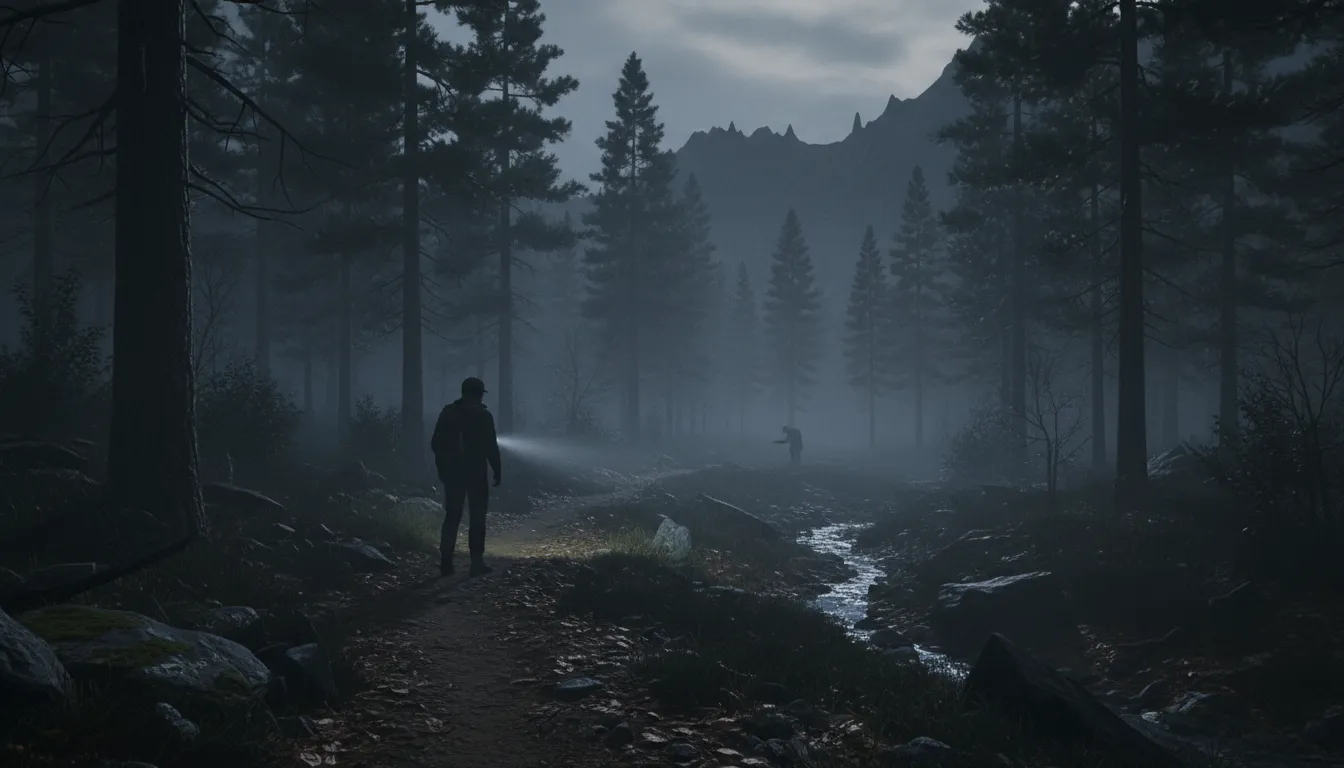
National forests have a way of pulling people in. Part of it is the beauty, obviously. The creeks, the ridgelines, the hush of pine and hardwoods, the feeling that the modern world has finally loosened its grip on your shoulders for a little while. But there’s another side to that same feeling. The farther you get from paved roads and cell service, the more you remember a simple truth.
Wild places do not belong to us.
Sometimes that truth shows up as weather, bad footing, or distance from help. Sometimes it shows up as strange people, stranger rumors, and the kind of split-second danger that makes your whole body go cold. These stories all come out of national forests and hiking country, and each one carries a slightly different lesson. One is about being hunted in terrain that feels like paradise until it suddenly doesn’t. One is about a local woods figure so bizarre he became a living legend. One is about getting trapped off trail and realizing how thin the line is between a good hike and a survival situation.
If there’s a theme running through all of them, it’s this: the outdoors can be incredible, but it demands respect. Not just for nature, but for unpredictability.
Table of Contents
- The Ozarks trip that turned into a nightmare
- The legend of Cornbread in Nantahala National Forest
- A brief but chilling reminder that trailheads aren’t always safe
- The sinkhole in Osceola and the case for staying on the trail
- What these forest stories actually teach
- Basic backcountry habits that these stories reinforce
- Why national forest stories hit differently
- FAQ
The Ozarks trip that turned into a nightmare
Between 2011 and 2015, two friends from Missouri built up a steady rhythm of hiking and camping together. What began as casual day hikes and some beers by a campfire gradually escalated into more serious overnight trips. They camped in local conservation areas, spent weekends roaming around Mark Twain National Forest, and slowly got comfortable enough in the woods that bigger adventures started to feel necessary.
That’s a familiar progression for a lot of outdoors people. A short, easy trip becomes normal. Then you want a little more mileage, a little more remoteness, a little more challenge. In this case, that urge led them south into Arkansas and into the mountainous portion of the Ozarks.
It’s worth pausing on that geography because it matters. When people say “the Ozarks,” they often picture one broad region. But there’s a world of difference between the flatter farm country farther north and the rougher, more folded terrain in Arkansas and Oklahoma. Down south, the land turns wilder. Hills stack up. Streams cut through valleys. Forest closes in. For backpackers and wild campers, it can feel like heaven.
Their plan sounded ideal. Park near the tiny town of Limestone, hike a leisurely 16-mile route over three nights, camp near Haw Creek Falls the first night, Big Piney Creek the second, then loop back toward Haw Creek for the third before returning to the car. They weren’t reckless beginners, either. They were experienced, they’d learned from previous mistakes, and they brought real gear.
Water treatment so they wouldn’t be dependent on carried water alone.
First aid kits in both packs so one injury wouldn’t leave both people helpless.
Bear mace for animal encounters.
A .357 revolver as a last-resort defensive option.
That level of preparation creates a sense of control. It should. Good gear matters. Experience matters. But one of the hardest lessons in the backcountry is that preparation can only cover so much. Some threats do not announce themselves in a way that lets you prepare properly.
A watcher at the treeline
The first day went beautifully. They reached Haw Creek Falls, set up camp, ate well, and turned in for the night. Then came the first warning sign.
The next morning, one of them woke to find his friend already up and standing near the treeline, staring toward the wooded slope near the falls. When he came back, he explained that a man had been watching their camp. At first that might have been odd but harmless. Maybe another hiker, maybe a local, maybe just someone curious.
What changed the tone was the behavior. When the camper waved, the stranger didn’t wave back. He jogged away. Then, while the camper was bathing at the falls, the same person appeared again some distance away and continued watching. On the walk back to camp, that creeping sensation of being observed hit him, and sure enough, the stranger was there again at the treeline, silently watching him leave.
Anyone who spends enough time outdoors eventually runs into people who are just plain off. Territorial locals. Confrontational hunters. Unfriendly strangers. The usual response is distance. If someone’s weirding you out, put miles between you and them. It’s practical and usually effective.
That’s exactly what they did. They packed up, hiked farther south, stopped for breakfast, and kept going. By dinner they had reached Big Piney Creek, taken a full dip in the water, and convinced themselves they had walked out of trouble.
They had not.
Something in the dark
That night, while sitting around a fire and passing a bottle of whiskey, they heard movement in the treeline near where their food bags were hung. At first they assumed it was an animal. That would have been the normal explanation. A deer sniffing around. Maybe a black bear trying its luck.
They ran over with flashlights, making noise, but never saw what fled. Then it came back, only this time it didn’t seem interested in the food. It moved in the darkness beyond camp, creeping and stopping, lingering for long stretches as if observing them.
That detail is what makes the whole thing so unsettling. Animals can investigate camp. They can circle. They can make noise. But this had the rhythm of something patient. Something curious in the wrong way.
Even so, because there had been no direct confrontation, they laughed off the tension. The mind wants normal explanations. A curious deer. A raccoon. Maybe nerves. Eventually the sound faded and they slept.
The next morning, they packed up again, planning to move toward a less visible campsite near the falls. By then they still had no reason to think all the weirdness was connected. They certainly didn’t think one person, or one presence, had been following them through the forest.
The child with the bow
Then came the moment that shattered every normal explanation.
During a midday stop on the trail, one of the hikers went a short distance uphill to relieve himself while the other waited below with the packs. Almost immediately, the one uphill called out in surprise as if he’d stumbled across a child or animal. The second hiker ran up to check.
There, standing in the woods, was a boy of about 11 or 12.
He looked neglected. Hand-me-down clothes. Brown hair. In his hand was a small bow, and on his back a quiver of short arrows that at first looked like toys. That illusion lasted only a moment. Up close, there were no padded tips. No safety caps. And when the boy placed an arrow on the string and drew it back, the tension in the bowstring made it obvious.
It was real.
They ran, or tried to. One scream of pain rang out, then another. By the time the second hiker reached the packs and turned, his friend had two wooden arrows sticking out of him. One in the shoulder. One lower, near the hip.
He grabbed the revolver, aimed at the boy, and fired. The child loosed another arrow, missed, and ran. The shot missed too.
There’s a horrible moral panic built into that moment. The attacker was a child, but also a very real threat. The injured hiker was furious that a second shot wasn’t taken as the boy fled. The shooter couldn’t bring himself to fire at a child running away.
It’s easy to imagine what you would do in theory. It’s very different when you are standing in the woods, your friend bleeding, a gun in your hand, and the person who just attacked you is young enough that every instinct screams against pulling the trigger.
Calling for rescue in hostile country
With no cell signal where they were, they had to move uphill to get reception. The injured hiker didn’t want to be left alone, even armed, in case the boy returned from cover. So they went together, one in severe pain and the other constantly scanning behind them with the gun ready.
Once high enough, they reached 911 and relayed GPS coordinates and a description of their surroundings. Dispatch told them not to remove the arrows because doing so could worsen the bleeding. The sheriff’s department began mobilizing ground search and rescue, but if terrain made that too slow, a helicopter would be needed.
Fortunately, the air system kicked in quickly.
A flight nurse called, talked them back downhill toward a clearing that could serve as a makeshift landing zone, and instructed them to stay visible. By then the injured hiker’s clothes were soaked in blood. He lay face down, trying not to move. The wait felt endless, but eventually the sound of rotor blades came in over the forest.
A medic descended, clipped the protruding arrows so the patient could be moved more safely, dressed the wounds, and got him into a specialized stretcher. The arrows stayed in place for removal at the hospital in a sterile environment. There was room in the helicopter for both men, and they were flown out together.
At the hospital, surgery went well. The arrows had missed anything vital. That was the good news.
The worse news came later, from law enforcement.
The most disturbing part was what came afterward
A deputy later explained that the search had turned up little. Then he delivered the sort of comment that stays in your head long after the physical injuries heal. He warned them not to expect much. In his view, the people living in those hills would likely protect the boy and close ranks against outsiders. He described “mountain folk” who lived by their own rules and implied that justice would be hard to come by.
He even gave his blunt opinion that the best outcome in the moment would have been for the shooter to kill the boy when he had the chance.
Whether one agrees with that or not, the remark reveals the level of menace the deputy associated with the situation. This wasn’t presented as a bizarre prank gone wrong. It was treated as an encounter with someone dangerous, someone perhaps protected by isolation and community silence.
The lesson here is ugly but useful. The wilderness does not just contain natural hazards. It also contains human unknowns, and distance can magnify danger rather than reduce it. When trouble starts in remote country, the timeline to safety gets much longer. Gear helps. Training helps. But nothing replaces caution when a bad situation starts to feel just a little off.
The legend of Cornbread in Nantahala National Forest
Not every creepy story from the woods is an outright attack. Sometimes it’s something murkier. A person known to the locals. A figure who becomes folklore while still very much alive. Someone harmless, maybe. Or maybe harmless only by local standards.
In a tiny North Carolina community near Nantahala National Forest, there was a man known as Cornbread. Nobody seemed to know his real name because he gave a different one every time he was asked. Kids who grew up nearby spent a lot of time in the woods, and eventually they started calling him Cornbread after hearing him yelling about it one day. The nickname stuck.
He was, by all accounts, a hermit. The kind of woods-dweller every rural area seems to produce sooner or later. He drifted in and out of trails, crossed paths with hikers, and lived close enough to civilization to become known but far enough outside it to remain mysterious.
The wholesome version of a very strange man
Part of what made Cornbread so memorable was that some of his odd behavior genuinely did sound almost sweet. He liked sharing his meals with birds. If he was eating from a can, he might place some food nearby, wait for a bird to come peck at it, and only then begin eating himself, smiling and laughing softly as though enjoying a meal with company.
He greeted trees. Not metaphorically. Literally. If children said hello to him in the woods, he might wave back and then turn to the surrounding trunks one by one saying, “Hello tree. Hello tree. Hello tree.”
He also built little stick shelters for animals. Tiny teepee-like constructions made from twigs and cord, scattered through the forest like miniature villages. He would stock them with food and check on them like a landlord making his rounds.
Read from a distance, these details almost paint him as some backwoods saint. A man more in tune with nature than the people around him. But in person, the line between endearing and unnerving gets thin fast.
A grown man talking to trees at night is not received the same way as a child doing it in daylight. Finding crude little stick structures deep in the woods is not charming when you suspect their builder is nearby, watching. What sounds whimsical in a story can feel threatening when you’re alone on a trail.
The creepy habits that fed the rumors
Cornbread apparently referred to himself as “we,” which is the kind of detail children find funny and adults find deeply concerning. People said he sang lullabies to trees after dark. There were rumors he kept mason jars in the woods filled not with trash, but with lost personal items: hair bands, gloves, loose buttons, things dropped accidentally by passersby. The idea was that he liked “finding a home” for anything someone lost.
Whether every rumor was true hardly matters. The point is that enough of them rang true because they fit what people already knew of him.
There were also strange little chairs made from sticks, too flimsy for a person to use. According to local talk, those chairs were built for ghosts. He would supposedly sit before them at night and wait for spirits to come tell him their stories.
Then there were the letters.
Cornbread wrote notes and fixed them to trees instead of mailing them. One found by local kids had been addressed to “tomorrow,” as if he were trying to correspond with the future. That, naturally, fed into another layer of legend: claims that he sometimes told hikers things that had not happened yet.
One story held that he told a woman her mother, who was seriously ill with cancer, was going to be just fine. A few weeks later, she got good news from doctors. Another rumor suggested he warned someone that their “time is short,” and that person later went missing elsewhere. True? Maybe. Maybe not. But eerie stories stick best when they can’t be cleanly disproven.
Why outsiders feared him more than locals did
The person telling this story never saw the darkest side of Cornbread directly, and there’s a telling reason for that. Cornbread was kinder, or at least gentler, with local kids. Outsiders got a different version of him.
He liked messing with hikers.
He was known for mimicking voices well enough to fool people. He once copied a friend’s mother so convincingly that nearby kids genuinely thought she had come calling for them. That same talent supposedly let him confuse college hikers by imitating one of their companions from somewhere in the trees.
He gave false directions too. More than one group apparently wound up good and lost after trusting whatever route he suggested. Solo hikers sometimes came back to their cars and found tiny carved figures left on them, made from sticks and detailed enough to resemble their clothes and hair. Instead of normal eyes, though, Cornbread carved little X’s.
That is exactly the kind of detail that tips weird into unforgettable. It means someone watched you long enough to render you in miniature, then approached your vehicle while you were deeper in the woods and left a message without saying a word.
He also had a habit of looking just over a person’s shoulder and smiling faintly, as if someone was approaching behind them. Again, childish as a prank on paper, but deeply unpleasant if you’re already unsettled.
Doors in the woods and lines you shouldn’t cross
As he got older, Cornbread reportedly became more intense and less soft around adults. He would insist that the woods used to have “more doors,” and become angry that he could no longer find them. He also spoke of invisible lines in the forest that were dangerous to cross, claiming that people who went missing had often crossed them without realizing it.
These ideas sound like classic hermit mysticism, but they’re effective because they merge with older fears people already carry into the outdoors. Hidden boundaries. Places you shouldn’t step. The sensation that wilderness has rules nobody fully explained to you.
More concretely, there were things locals saw for themselves. Cornbread would sometimes stand utterly motionless in one place for what felt like hours, unresponsive even if spoken to. On one occasion he told some children, very matter-of-factly, that he had not slept in years because, in his words, “it’s safer if one of us stays awake.”
“It’s safer if one of us stays awake.”
That line alone could keep a person up at night.
Eventually sightings dwindled. The assumption now is that Cornbread died out there somewhere in the forest he had made his home, slowly becoming part of the landscape that had always seemed to hold him halfway between man and legend.
What makes this story memorable is not just that he was strange. It’s that nearly every community with real wilderness nearby has some version of this figure. A local eccentric. A trail ghost who is technically alive. The person who knows the woods better than anyone else, but whose mind has gone so far sideways that nobody can fully decide whether he’s a danger, a guardian, or both.
A brief but chilling reminder that trailheads aren’t always safe
Tucked between the larger stories is a smaller one, but it lands hard because of how personal it feels.
During a reunion hike with old college friends in Angeles National Forest, one hiker returned to the trailhead to discover that his car was gone. At first it seemed like a straightforward theft. Bad luck, infuriating, but ordinary enough by modern standards. He reported it, went off with friends to eat and drink, and tried to process it.
Then police found the car only a few hours later, abandoned off-road down a trail. The unsettling part was not just where it had been left. It was what the thief had done inside.
An old photo album had been in the vehicle, filled with college-era memories including hiking photos. One picture showing only the owner had been removed and stabbed into the dashboard with a knife that clearly belonged to the thief.
Was it random? Possibly. Could a deranged thief have simply grabbed a photo and chosen one face by chance? Sure. But once something like that happens, randomness stops feeling random. The deputy even asked whether anyone might want to do him harm.
Insurance covered repairs, the car came back, and yet the feeling never left. He sold it at a steep discount just to get rid of it.
There’s a practical reminder buried in that story too. Outdoor danger doesn’t begin only when you hit the trail. Trailheads, parking lots, and remote access roads are part of the equation. They are isolated, predictable places where people leave valuables and disappear for hours. Sometimes the creepiest moment of a hike happens after you think it’s over.
The sinkhole in Osceola and the case for staying on the trail
The final story shifts away from threatening people and back toward the raw unpredictability of terrain itself.
After college, a woman in Jacksonville found a hiking routine with two friends she met through yoga. Hiking became more than exercise for her. It was stress relief, grounding, and one of those habits that starts to feel essential once it becomes part of your life. So when both friends canceled one day, she decided to go alone.
Her destination was Osceola National Forest in Florida, a place of swamp, wildlife, and enough dry land to make for a solid day hike. Beautiful, eerie, and full of exactly the sort of scenery that invites a person to step just a little off trail to soak it in.
The ground gave way without warning
It was early afternoon when she left a sandy trail and moved onto soft earth padded with pine needles. Nothing about the ground seemed suspicious. It had some give, but not the unstable, waterlogged kind. It looked peaceful. Safe enough.
Then the earth opened beneath her.
She fell into a sinkhole, dropping fast before becoming wedged where the hole narrowed toward the bottom. Dirt filled her eyes. Her legs were scraped and trapped. Movement was almost impossible. Above her, only a small patch of light remained.
That alone would be terror enough, but what truly defines this story is the waiting. No dramatic scramble out. No convenient passerby. Just one trapped person in near-darkness hoping her emergency plan would work.
The small device that likely saved her life
On her backpack she had a Garmin inReach, a satellite-based tracking device. She could not reach the SOS function because the pack was inaccessible in the position she was trapped in, but the unit still broadcast her location. Family and friends could check it online using her login information.
In other words, she had one thread connecting her to the outside world, and all she could do was trust it.
That kind of trust sounds simple when you’re comfortable at home. In a hole in the ground, unable to move, it becomes a mental battle. She had to believe someone would notice she wasn’t moving. Believe they would call. Believe the device still worked at that depth. Believe help could find her before dehydration, exposure, panic, or flooding made things worse.
Night made all of it worse. Rain started. Bugs became relentless. She imagined the hole filling with water. Her phone buzzed in her pocket with incoming calls she couldn’t answer because she was pinned in place.
Strange as it sounds, those unanswered calls became a source of comfort. They proved that someone knew something was wrong.
How search and rescue got her out
Eventually voices came from above. Search and rescue had located her. That moment brought fresh panic too, because the mind immediately invents a new fear: what if they find me but still can’t get me out?
Fortunately, the rescue team knew exactly what they were doing.
A medic came down first with water and calm reassurance. Another rescuer assessed the hole and explained that the walls were stable enough for a quick extraction without heavy digging. More team members descended with compact tools, loosened the dirt around her hips carefully, and slid her into a rescue litter with straps and a harness. Then they winched her up steadily to the surface.
She emerged into darkness and light rain, cold and shaken, but overwhelmingly relieved. An ambulance was waiting on the trail, and even a helicopter had been placed on standby in case her injuries proved more serious. In the end she escaped with a badly sprained ankle and a memory she never forgot.
From fall to home, the entire ordeal lasted roughly 13 to 14 hours. That is not a long time in calendar terms, but any stretch of fear changes shape in the body. It can feel like a lifetime.
She still hikes, just with more caution, less adventurous destinations, and one rule she now repeats to her children:
Stay on the damn trail.
What these forest stories actually teach
It’s easy to file tales like these under entertainment and move on. Creepy kid with a bow. Forest hermit. Sinkhole survival. But they also contain genuinely useful lessons for anyone who spends time outdoors.
1. Distance from help changes everything
In a city, an assault means dialing emergency services and expecting rapid response. Deep in forested terrain, the same injury becomes a logistical problem involving signal, coordinates, extraction routes, and potentially aircraft. A wound that might be survivable in one setting becomes critical in another because of time alone.
2. Unease is information
The first hikers did the right thing when a stranger’s behavior felt wrong. They moved. That instinct matters. You do not need hard proof of danger before creating distance. If someone in the woods is watching too much, following, or behaving unpredictably, trust that discomfort.
3. Trailheads deserve the same caution as trails
Remote parking areas are vulnerable spots. Lock vehicles, leave nothing visible, and remember that your car can tell strangers a lot about you if they spend time with it.
4. Satellite devices are worth their weight
The inReach in the sinkhole story was not a luxury gadget. It was the thing that prevented a disappearing act from becoming a fatality. Cell phones fail in the backcountry all the time. Satellite communicators fill that gap.
5. Staying on marked trails is not boring, it’s smart
Most people leave trails for harmless reasons. Better views. A bathroom break. A few quieter moments in the trees. Usually nothing happens. Until something does. Hidden holes, unstable ground, unseen drop-offs, and disorientation all become more likely the moment you leave the maintained path.
6. The woods contain human weirdness too
Most outdoor safety advice focuses on weather, water, wildlife, and injury. All of that matters. But strange, unstable, or hostile people are also a real part of wilderness risk. It’s uncomfortable to admit because nature is supposed to feel like an escape from human problems. Sometimes it is. Sometimes it absolutely isn’t.
Basic backcountry habits that these stories reinforce
Tell someone your exact route and expected return time.
Carry navigation and emergency communication gear.
Bring trauma supplies, not just basic bandages.
Do not assume another person in the woods is harmless because they are young, local, or odd-looking.
If a situation feels wrong, move early rather than late.
Limit off-trail wandering unless you truly know the terrain and accept the risks.
Be careful what you leave in vehicles at trailheads.
None of these habits guarantee safety. Nothing does. But they raise the odds in your favor, and in remote places, a small edge can matter a lot.
Why national forest stories hit differently
There’s something especially unnerving about stories from national forests compared with urban horror or suburban crime. Maybe it’s because those places feel expansive enough to swallow context. In town, strange behavior has witnesses. Roads, cameras, neighbors, routine. In the woods, there’s room for ambiguity. Room for someone to watch from a treeline. Room for a hermit to become folklore. Room for a person to vanish into terrain or into rumor.
That ambiguity is what lingers.
The boy in the Ozarks may have come from somewhere nearby, maybe from a family or community that knew exactly who he was. Or maybe not. Cornbread may have been mostly harmless, or he may have had edges nobody local wanted to test. The thief at the Angeles trailhead may have been random, or may have chosen his target with intention. The sinkhole in Florida was “just” geology, but it still transformed a pleasant afternoon into an overnight entrapment.
In each case, what makes the story powerful is not only what happened. It’s what remains unknown around it.
FAQ
Are these stories mainly about supernatural events?
Not really. The strongest thread running through them is real-world danger in remote places. One story involves a local woods legend with almost supernatural rumors around him, but the events themselves are grounded in human behavior, isolation, and survival.
What is the biggest safety takeaway from the sinkhole story?
Carrying a satellite tracking or communication device can be life-saving, especially when hiking solo. The other major lesson is simple: staying on established trails dramatically reduces the risk of hidden terrain hazards.
Why didn’t the injured hikers remove the arrows themselves?
Removing embedded objects can worsen bleeding and damage surrounding tissue. They were specifically instructed to leave the arrows in place until medical professionals could handle them in a controlled setting.
Are strange people in national forests a realistic concern?
Yes. They are not the most common risk compared with injury, weather, or navigation mistakes, but remote outdoor areas do sometimes attract unstable, isolated, or predatory individuals. Situational awareness matters.
What should you do if someone in the woods is acting strangely around you?
Create distance early, avoid escalating if possible, stay aware of your route, and be ready to contact authorities when safe. If you feel watched or followed, take that seriously and prioritize getting to a more secure area.
Why are trailheads mentioned as a safety issue?
Trailheads are isolated and predictable. People leave their vehicles unattended for hours, often with valuables or personal information inside. That makes them attractive spots for theft and, in rare cases, targeted intimidation.
Forests are still worth visiting. That should be said plainly. Nothing here is an argument against hiking, camping, or spending time in wild places. If anything, these stories underline why people love it so much in the first place. The outdoors strips things back. It makes you alert. Grateful. Present.
But it also asks for humility.
Go prepared. Respect the terrain. Respect your instincts. Keep your emergency options solid. And if the woods ever start feeling wrong, don’t argue with that feeling too long.
Sometimes the creepiest thing in a national forest is not what you can hear. It’s what you can’t explain.