
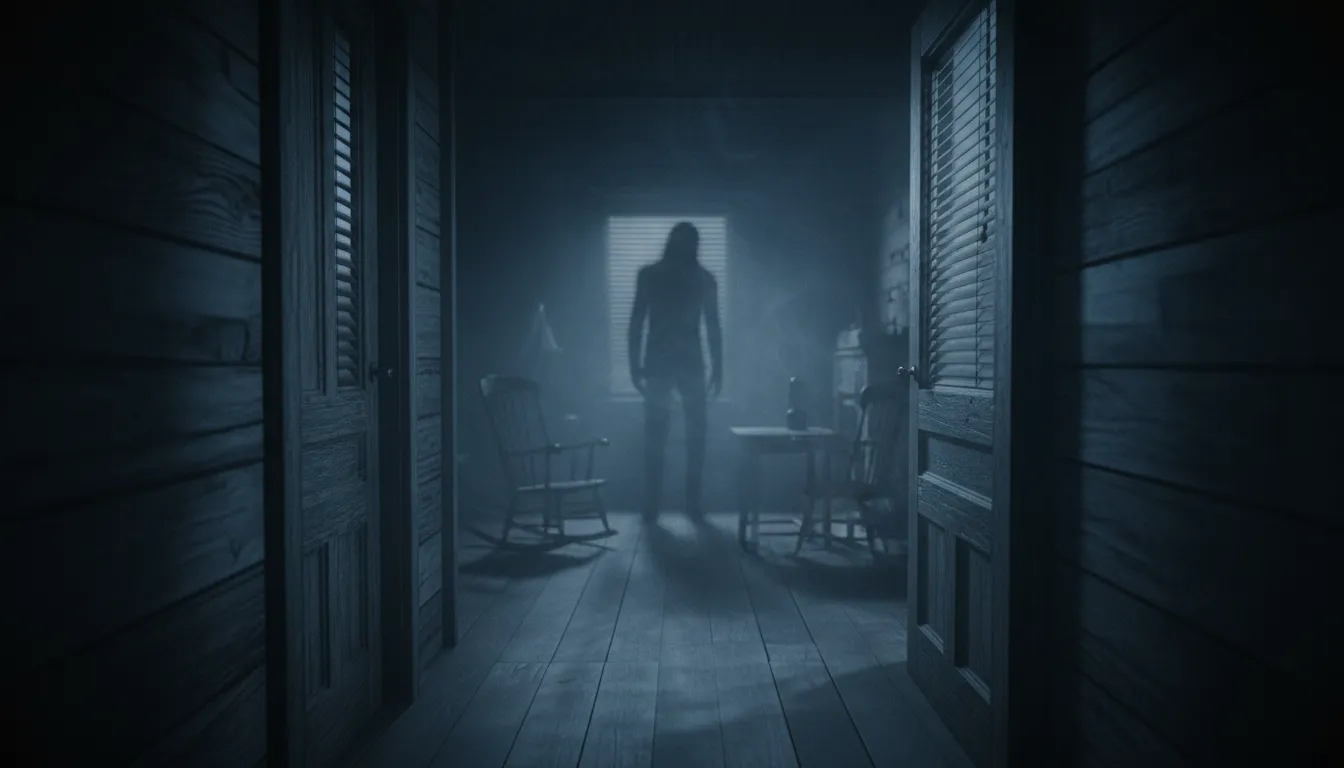
Some nights you are just tired. Other nights, the house feels too quiet. The air feels slightly wrong. And then the noises start. Maybe it is a door handle turning when everyone is asleep. Maybe animals freeze in a way they never do. Maybe you hear a voice that knows your name, even though nobody should be there.
Below are six allegedly true horror stories drawn from listener accounts. Each one is different, but they share a common thread: the feeling that something is not only present, but paying attention.
Note: These stories are presented as told. Some accounts may have natural explanations. Others do not. The goal here is not to “prove” anything. It is to explore the unsettling patterns that show up when people believe something supernatural might be involved, and to consider what you can do when you find yourself in situations you cannot explain.
1) My Husband’s Imaginary Friend (Paranormal Activity in the House)
Christy wrote in with an experience that started almost innocently, at least in her mind. When she moved into her husband’s house, her husband was still deployed overseas. Early in their relationship, she did not want to sound irrational, so she kept quiet.
What she felt was not a specific event. It was worse than that. It was an overwhelming sense of being watched, especially when she was upstairs in the bedroom. No footsteps. No clear figure. Just that tight, constant awareness that something was paying attention to her.
Then the nightmares began.
They started like sleep paralysis, where you feel awake but cannot fully move. Christy would wake in bed, turn her head, and see a little pale girl standing beside the bed. The girl had short dark hair and, in the dreams, sharp jagged teeth. At first, she looked normal, just like a child.
But in every dream, the girl would lunge at Christy. The nightmare occurred about once a week. Christy did not even like horror movies. She also did not see herself as a child in real life that way. She could not explain why this girl showed up in her mind.
Eventually the nightmares got physical. Her husband would wake up because she was crying and moaning in her sleep. After one particularly terrifying dream, she decided she had to talk to him.
Once she asked him, she learned she was not guessing. She was describing something he already knew.
She asked if he had ever had strange experiences in the house. He told her he had not, but then said, “Actually, I did have an imaginary friend.”
Christy pressed him to describe the imaginary friend. He said it was a little girl, pale, short dark hair, jagged teeth.
That is when Christy started to break down, because the details matched her dreams so closely it felt like the nightmare was not about her imagination at all. Her husband clarified that the girl was not scary as a child. They played together in his dad’s house. But as he grew older, the imaginary friend faded away.
Christy tried to label it as stress or depression from everything going on. But then the house started doing things that were not “in her head.” Things went missing. Keys showed up in weird places. Doors opened and closed on their own.
Even the food spoiled too fast. Christy could buy unripe produce, like bananas, and within two days it would turn black and moldy. Her husband insisted none of it was paranormal. But the pattern was undeniable.
And then, one night, it turned into something fully awake and immediate. Her husband woke her and asked if she saw what he saw. They watched items being moved around on the dresser with no one in sight.
Then, three loud knocks came on the door.
That was the moment Christy said she refused to stay asleep in the same bedroom. They moved to the spare room, and from that night on they heard footsteps above them, walking around like someone was moving through the bathroom and hallway. It was relentless.
Sleep became impossible.
His mother, who was spiritual, concluded something that sounds both unsettling and strangely logical to the people involved. She believed the little girl from his childhood had attached itself to him. And now, with Christy in the picture, the entity became jealous.
She instructed them to smudge the house, wipe vinegar on door frames and window frames, and acknowledge the spirit while making it clear it was not welcome. Christy and her husband did what they were told.
The activity stopped.
Produce stopped rotting quickly. The footsteps stopped. Nothing happened again in that house.
Whether you call it paranormal attachment, jealousy, or childhood memories resurfacing into trauma, the story has one undeniable takeaway: when multiple strange events cluster together, people often start looking for a source that explains the pattern, not just one-off scares.
2) I’m Not Supposed to Talk About What Happens at Wilderness Therapy in the Utah Mountains
Abby’s story began with getting kicked out of boarding school. The day after Christmas of 2023, she was sent away from Montana to something her boarding school peers described as “wilderness therapy.” Abby assumed it would be simple, like hiking and camping.
She was excited because she wanted out of Montana fast. They picked her up at around 3 a.m. and it was a brutal 14-hour drive. She got processed like a new intake: vitals checked, gear given, and then she was put into a van that drove another hour, with 84 miles to the closest town.
Then it hit her: she was in the middle of nowhere, on a mountain. A light up the hill became the camp’s location.
They put her in a yurt. For those unfamiliar, a yurt is basically a large tent structure that can sleep a small group. Abby shared it with four girls and three staff, and the staff rotated every two to three days.
The first set of staff felt normal. They taught her how to cook and how to stay warm. Abby did not obsess over where they were staying, including that it was on native land.
But then a new pair arrived: a man and a woman who spoke differently, more like they were trying to frighten and impress the girls at the same time. They told stories about “crazy things” they experienced in the wilderness, things Abby’s native friends recognized from elder legends.
The staff’s stories were enough to make Abby nervous, but she still tried not to focus on it. Then one night, on the walk to the outhouse, she saw something she said she will never forget.
It was pitch black. The only light was moonlight. Abby, her friend Emily, and the female staff member Stella walked in a line along the path.
Stella suddenly shushed them.
“Keep your eyes down. Don’t look up,” Stella told them.
Of course, because humans are curious, Abby’s group looked up anyway.
Eight feet behind them was a shadow figure moving along the path.
Abby screamed. Emily screamed. Stella kept shushing them, instructing them to stay calm, not interact, and keep their eyes on the ground. Stella implied that if they ignored it, it would go away.
They returned to camp shaken, and Stella said it happened “all the time.”
The next night Abby could not sleep. She heard whispering outside the tent even though there were staff awake on shifts. She said the whispering continued long after, and staff members claimed they could not hear it.
Weeks later, she woke to footsteps moving around the area outside the tent. When she reported it, they were told it was probably snow falling off the yurt’s frame.
Abby disagreed. She said it was not snow.
Then came a night where the pressure on her chest became so intense she could barely breathe. A whisper rose from the darkness. Abby described it as raspy, like someone who smoked heavily for decades.
It whispered her name, right next to her head.
She said the night staff again claimed they could not hear anything and told her to go back to sleep.
Other girls reported similar experiences. One night around the fire, a girl cried because she saw a shadow person standing next to the yurt. There were also incidents where staff were called for boys from another camp who complained about laughing outside their tents, even though headcounts showed everyone was inside.
The worst incident Abby described involved a hike up a mountain. They climbed, watched sunset fade, and began hiking down. Darkness was so complete they needed to hold onto each other’s backpacks to avoid losing the group.
When they counted heads, Abby said there was a ninth body in their chain. There were five girls and three staff, and yet nine. They never found out who the extra “person” was.
Abby stressed respect and context at the end of her email. She was back in Alaska now and happy to be gone, but said those were native lands and they were not there first. She also added a deeply personal detail: she is deaf and yet she said she could hear the voice of a man living in the barn or in her woods.
There is no easy way to interpret a story like this. But it offers a chilling theme: environments can make people feel watched, and when that feeling is paired with consistent, shared encounters, it becomes harder to dismiss.
3) I Think There’s Someone Living in My Barn But I’m Deaf and I Can Hear His Voice
Sophia’s subject line was a warning in itself: “Oh my god.” She told a story from a farm her family purchased about five years earlier. The farm was built in the 1940s, and everyone in the family had always felt a presence in the barn.
It did not start with dramatic apparitions. It started with animals.
Sometimes, Sophia said, livestock would stop and stare at a particular spot in the barn. Other times, she would walk in and the animals would freeze completely, including chickens and roosters. Seeing animals pause like that makes even skeptical people feel unsettled.
The cats and dogs were worse. They refused to go into the barn even though the dogs typically work the stock. Sophia described them stopping at the doorway, not entering.
Then the summer brought escalation.
After dusk, family members started hearing noises in the woods like coughing or voices that did not belong to anyone in the family. Sometimes they reported silhouettes of a man in the distance, though not always at the same time.
Little brother heard tapping at his window at night, and whenever he checked, there was nobody there. He also had dreams of a man standing at his window staring at him.
Sophia herself had dreams of waking up and seeing a man standing in the yard looking up toward the second story of their home.
She said her family tried to explain it as group thinking at first. But then she noticed how her cow behaved. The cow was generally calm but sometimes seemed unnecessarily spooked. When Sophia left barn doors open and stood out there, the cow would stare into the distance with ears pinned back.
At times Sophia looked to track what the cow was staring at. She claimed she would see a silhouette moving in the trees.
She also described a moment that felt personal and impossible to ignore: she heard or noticed boot prints on fresh snow that appeared to follow her. The prints ended abruptly.
She emphasized that the “prince” (she meant person/print) was not there when she had come out.
Then the story shifted from “something is around” to “something is talking.”
Sophia described being hard of hearing. She had hearing aids but did not wear them in the barn because she worried they could alter her perception of how close sounds are, which could be dangerous around large animals.
While working in the barn, she heard a very deep voice behind her say, “hello.” She turned around and there was nobody there.
She called out, assuming it could be someone in the family. But nobody was there. She ran back in and saw everyone’s boots were dry, and nobody else had gone into the barn.
She said the voice was too deep and too loud to be an animal.
It happened again: she heard someone call the male version of her middle name. (For example, if her middle name is Josephine, it would be “Joseph.”) She said it sounded so clear she believed whoever spoke was standing directly behind her.
She did not tell her siblings immediately because she did not want to scare them. But she did not feel safe pretending it was nothing.
About two weeks before she wrote the email, Sophia and her mom were cleaning the barn. The barn had two sections and two aisles. Sophia’s vision was not fully blocked, so she could see what was happening.
Her mom suddenly turned and asked, “Are any of the animals loose?” She said she had just seen something crawling down the aisle in the other section. The aisle ended in a dead end. There was nowhere for something to go.
When they checked, there were no animals loose, and nothing remained in that space.
Sophia questioned whether this was supernatural or whether a person was hiding in the forest. She said their property backed up to a nature reserve in rural Illinois and that it was too remote for a neighbor. She noted that anyone entering the property would have seen headlights if they drove onto it.
Either way, the conclusion she reached was strong: she fully believed there was a person, and she wanted to know how to make the presence “go away.”
This story hits hard because it combines consistent animal behavior with auditory events that Sophia believed she could not misinterpret. Her hard of hearing becomes less of an “excuse” and more of a complication. When you cannot always trust sound, an intelligible voice becomes even more unsettling.
4) The Quiet Hours in a Residential Care Facility
Marcus wrote in with a story that is creepy in a very specific way. It is not about one dramatic ghost sighting. It is about routine horror, the kind that happens when you work nights and you start noticing a pattern.
He worked as a caretaker in a residential care facility located in an old Victorian manor. The building had original architecture: archways, creaky staircases, a lot of shadows.
The manor was independently owned and, according to Marcus, there were no cameras inside. There was a camera at entry and exit, including the front door and back door.
At night, by midnight, all residents were asleep. Marcus said he was nocturnal anyway, so he did not mind working nights as long as he stayed alert.
But certain things started going missing during the night.
Eggs disappeared. Food cartons vanished. Cans of soup were taken. Even towels and toiletries went missing.
The staff suspected someone was getting out of bed, but that seemed unlikely because people were under strict diet requirements. Nobody needed to hoard food. And if anyone was entering, cameras on entry and exit would have caught it.
Then Marcus noticed another clue: tapping at night and a sour smell coming through the vents. He had maintenance or plumbers check it, but they could not find an issue, and they suggested the plumbing might just be old and needing replacement.
Marcus felt it was connected because it happened only at night.
Then came the moment he described as undeniable.
One night around 3 a.m., he lay down on the couch in the lounge and closed his eyes for a minute. Residents knew where he would be. He set his flip phone on a coffee table next to the couch.
He woke abruptly. The phone was still charging on the table, just where he left it. But he thought he heard a noise.
From the couch he could see a hallway through archways. He looked and saw something dart across the archway on all fours. It looked humanoid but too small to be one of the residents, like a child.
He dismissed it at first as a momentary perception error. Then, as he sat up, he looked at his phone again.
He described a hand coming out from behind the couch, reaching for the phone. The hand was thin, grayish skinned, with long nails. He said there was a silent tug-of-war, a physical struggle over the phone, powered by something with unnatural strength.
He finally grabbed the phone and the hand let go and disappeared back behind the couch.
He pulled the couch away from the wall and checked behind it. Nobody was there.
He checked every resident. Everyone remained asleep.
The next day his supervisor relieved him and Marcus told her what happened. At first, she assumed he was tired from nights. Marcus pushed back persistently and eventually she believed him enough to call maintenance.
Maintenance checked for entry points. When they went into an unfinished attic used for storage, they found piles of blankets, empty cartons of food, and a sour damp smell.
Behind an insulation panel they found a woman who had been living there, apparently using an unused servant stairwell that slipped into the attic.
Marcus said there was no evidence of another intruder in the house. But he suspected there may have been someone else because he felt he saw two figures that night.
He ended by saying that the concept of “frogging” is one of the creepiest situations, because it means a person is living in your space without you realizing it. Even if the intruder was nonviolent, the violation of privacy and safety is terrifying.
Whether it was a supernatural creature or a hidden person, the emotional truth holds: the building was old, unmonitored in certain areas, and the missing items plus the smells formed a trail that no camera could see.
5) My Father-in-Law Became Obsessed with Me and May Not Have Been Entirely Human
M’s story is long and layered, and the way it unfolds builds dread instead of releasing it. It starts with a man who feels off, escalates into obsession and manipulation, and then shifts into encounters she interprets as something deeply evil.
She was not religious, though she believed in God. Her relationship moved forward with her fiancé, but before it became stable, she and her fiancé were forced to move into the home of her fiancé’s father due to financial strain.
She had a strong dislike for her father-in-law, “Phil,” but she told herself it was just discomfort. Before they moved in, his wife (her future fiancé’s mother) warned her to be careful and said Phil was dangerous. She described him as having a “bad soul.”
It did not fully register at first because they were not the kind of couple who ran to spiritual explanations for everything. They tried to make it work, ignore what bothered them, and save up money for their own place.
But the situation worsened quickly.
Phil had a record of past behavior. He had heard voices and believed his wife was cheating, which led him to stalk her. M said she thought she was dealing with mental instability. That was her early framing.
In February 2019, they got a puppy that had anxiety issues. She told Phil the dog needed careful handling. But when she left and returned, she found the dog defeated in its kennel and limping.
She suspected Phil injured it. From that point, the house’s conditions turned sour: rat and mouse infestation, cereal boxes chewed at the corners, and a horrible smell coming from the walls, which she connected to something dead or trapped in the walls.
Phil did not seem to care enough to handle it. He minimized the problems.
Then came voices.
M said there were times she heard voices calling her name that sounded like her fiancé talking, and vice versa. She would hear him from downstairs while he was upstairs. Eventually, she experienced it in ways that made it hard to explain as coincidence or imagination.
The emotional atmosphere in the house changed too. M said they used to be happier, but every time they were inside, they felt miserable and angry without reason.
Then the story becomes sharply uncomfortable. Phil’s behavior started to include sexual harassment and manipulation, including walking in on her in the shower. She said her fiancé confronted Phil, but Phil claimed he did not know she was in there because the door did not lock.
M’s fiancé, she said, seemed unable to see what she was dealing with. He brushed it off repeatedly, as if Phil was harmless or misunderstood.
It escalated further. Phil’s new girlfriend accused M of cheating and pointed to evidence. She claimed M’s photo under his mattress meant M had a relationship with him.
M denied it. But then the girlfriend showed screenshots: messages allegedly sent from M’s phone admitting she wanted Phil and that they were intimate.
M claimed she never sent those messages. Then to make matters worse, the girlfriend said she forwarded the claim to M’s fiancé’s sisters, who confirmed they had heard Phil say M admitted being obsessed with him.
M described feeling alone and hyperaware of Phil’s gaze. She said he hovered too close, too often.
Eventually she had a direct encounter. She woke at 3:33 in the morning, hearing a creek in the room. She saw what she described as a massive creature standing in the doorway. She felt in her gut that it was “here for me.” She could not scream, and she paralyzed herself by squeezing her eyes shut and then opening them again.
The doorway, she said, held a single deflated balloon.
After that, she knew she had to leave. She started packing her car. She looked at Phil outside doing yard work and said the shadow casting across the lawn was not his shadow. She believed it had pointy features and horns.
She went back inside and told her fiancé she was leaving. Phil walked in behind her and told her they needed her to stay. Her dog protected her by growling and blocking her path.
She escaped upstairs, slammed the door, and heard her fiancé calling her by her nickname, “Love Butt.” But she said something felt wrong. Then she heard a voice outside her door that sounded like her own, saying something like, “Stop being such a scared little bee.”
She called the police. She said Phil ran downstairs when he heard that. Her family later came with two brothers, and they moved her out.
She ended the email with a final note: although her fiancé and she stayed together and later got counseling, she never wants to be close to Phil again. She still does not know whether the house was haunted or whether Phil’s energy attracted something evil.
This story is heavy and difficult. But it underscores a crucial principle: when someone has already shown patterns of harm and manipulation, your fear is not “overreacting.” It is information your body collects. And if you ever feel like reality itself is being twisted around you, leaving is often the safest “proof” you can offer yourself.
6) Something Outside My Cabin at Big Bear
Alexander’s story takes place in 2010, when she and her family planned a big girls trip to Big Bear. They rented a cabin, and one detail immediately stuck out: a giant treehouse attached to a nearby tree.
The treehouse was boarded up, which at first felt like a normal inconvenience. Maybe the previous tenants just did not want people going there.
But Alexander and her group still heard noises coming from the treehouse when they pulled up. The cabin was full of family members sharing rooms, with a cramped arrangement that left Alexander sleeping on an air mattress near the door.
That night, while she was half awake, she watched the door handle start turning.
Her family was asleep. She expected someone to come in, but the door handle stopped as if nobody were there. Then it turned again and the door opened slightly, about a third of the way.
Nobody entered.
Alexander called out. No answer.
She checked the hallway. Nobody. She checked her mother’s room, her aunt’s room, and her grandmother’s room. Everyone was asleep. So she retreated to bed, pulled the covers over her head, put in AirPods, and tried to sleep.
She dreamt of a little girl with red hair and pigtails wearing a long white dress with blue bows, running up and down a green staircase.
It was unsettling but manageable, until she told her sister about the dream. Her sister reacted with shock and said she had the same dream.
And more specifically, her sister said the little girl had freckles. Alexander had not told her about freckles.
Now the trip felt different. It stopped being “vacation cabin weirdness” and became “this place is holding onto something.”
Later that night in the hot tub, they heard noises again from the treehouse. It sounded like pacing, like footsteps on two legs above them, stomping and trying to be heard.
They decided to stop pretending and went inside. Even there, the sounds continued. They reported hearing howling from the treehouse.
Alexander said she has never been so happy to get home.
The emotional takeaway here is not just “something happened.” It is that multiple family members experienced consistent events across nights, including shared dreams with matching details.
Patterns Behind “Unexplainable” Experiences
Even though these six accounts differ, they repeat certain themes that tend to show up in paranormal story collections and personal reports.
1) Claimed “attention” from an unseen presence
Christy described an overwhelming sense of being watched. Abby described creatures walking and whispering. Sophia described a voice calling out in the barn. M felt watched and targeted. Marcus felt observed enough to have a hand reach for his phone. Alexander felt a presence through noises and door activity.
2) Clustered events, not isolated scares
A single scary moment can be a glitch in perception. A cluster creates a pattern: missing items, repeated noises, escalating threats, animal behavior shifts, multiple people reporting the same thing.
3) The “environment” changes the story
Older buildings, remote camps, barns, attics, cabins. Many are enclosed spaces with old architecture or limited monitoring. The stories suggest that space matters. When you remove access to exits, cameras, and immediate help, fear becomes amplified.
4) People try to dismiss it, then stop
Christy did not want to tell her husband at first. Abby initially treated the legends as jokes. Sophia tried to explain things as group think or animals. Marcus thought he might be tired. M tried to interpret Phil as “unstable,” not dangerous.
Every story includes the moment when denial ends, and action begins: leaving a bedroom, relocating, calling maintenance, calling the police, leaving the property.
What You Can Do If You Experience Something You Cannot Explain
Even if you think a situation is paranormal, you still want practical safety steps. The goal is to reduce harm while keeping your mind open to possibilities.
1) Document details, not just fear
If you can, write down time stamps, what happened, who else noticed it, and any physical details. In many of these accounts, the recurring specifics helped the storytellers connect dots. Without notes, it becomes easier to second-guess yourself later.
2) Eliminate ordinary explanations when possible
People in these stories often did check plausible explanations. Marcus had maintenance look at vents and plumbing. Sophia asked whether someone might live in the woods. Abby noticed it was happening on a schedule and in patterns. You do not need to choose between “supernatural” and “natural.” You can check both.
3) Change your environment when you need to feel safe
Christy moved to the spare room when sleeping in the primary bedroom became unbearable. When people feel targeted, sleeping location can matter emotionally. If something is escalating, leaving a room or property can be the most immediate form of self-protection.
4) Involve the right kind of help
For physical intrusions, call professionals. For threats, call authorities. For spiritual concerns, some families seek spiritual support, like smudging and cleansing. The key is choosing help that matches the risk. If it feels unsafe, do not wait for perfect proof.
5) Protect your credibility
One reason people stay quiet in these stories is fear of being called crazy. If you are worried someone will dismiss you, consider involving a neutral third party: a friend who can verify details, a building inspector, a caretaker, or medical professional if sleep paralysis or nightmares feel connected to stress.
FAQ
Are these stories proof of ghosts or demons?
No. They are presented as allegedly true accounts. Some incidents could have natural explanations like hidden intruders, building quirks, pests, sound distortions, or stress-related experiences. Still, the consistency across multiple accounts and multiple people noticing similar details is what makes these stories emotionally compelling.
Why do so many paranormal stories involve older buildings or remote locations?
Older buildings often have hidden spaces, outdated wiring, drafts, and construction gaps that can conceal people or animals. Remote locations can add isolation, limited staff oversight, and environmental factors like darkness and unfamiliar terrain. Isolation also intensifies fear, which can make strange sensations feel more threatening.
What should I do if I hear voices or feel watched at night?
Start with safety. Check for immediate hazards and verify normal explanations if you can. Document what you experience. If you feel threatened or unsafe, contact local authorities. If it is primarily affecting sleep, consider speaking to a healthcare professional because sleep paralysis, nightmares, and anxiety can create experiences that feel extremely real.
Is smudging or vinegar cleansing effective?
There is no scientific evidence that smudging or vinegar cleansing removes spirits. However, some people find these rituals calming and empowering, especially when paired with practical actions like improving safety, addressing pests, or changing sleeping arrangements. The emotional and behavioral impact can be real even if the cause is unknown.
How can you tell if an “entity” might actually be a person?
Look for physical signs of access: footprints, disturbed locks, missing items that fit human behavior, or evidence of habitation like food caches. If cameras show no entry, check hidden areas, attics, crawl spaces, and unsecured doors. In Marcus’s story, the “creature” may have been a hidden intruder living in the attic.
What does it mean when animals freeze or refuse to enter a space?
Animals may respond to scents, sounds, vibrations, pests, unfamiliar people, or changes in routine. In paranormal accounts, these reactions are sometimes interpreted as detecting something human or nonhuman. If it happens repeatedly, treat it as information: inspect the space for hazards, pests, and intruders, and consider speaking to a local wildlife or farm professional.
Final Thought: The Real Horror Is the Uncertainty
The scariest part of these stories is not always what is seen. It is what cannot be explained, especially when the experience repeats and connects to other people and other details.
Christy’s imaginary friend. Abby’s whispered name in the Utah wilderness. Sophia’s voice in the barn. Marcus’s hand reaching for a phone in an empty hallway. M’s certainty that something horned was not human. Alexander’s shared dream and howling treehouse.
Even if you never believe in paranormal entities, you can still respect what the storytellers describe: fear has patterns. People notice consistency. And when reality feels unstable, the most important thing is to protect yourself and take action.
If you want to share your own experience, consider submitting it to a trusted community platform. The goal is not to mock or bully anyone. It is to give people a place to describe what happened, compare patterns, and hopefully find safety in the process.